How Decision Optimization Improves Credit Line Management
Action-effect models and prescriptive analytics make credit limit increase optimization a powerful tool to improve portfolio performance

Key Takeaways:
- Credit offer optimization is a strategic imperative for portfolio growth. Credit line management optimization goes beyond profit maximization; it enables issuers to simultaneously manage exposure, balance income against risk, and deliver compliant, personalized credit decisions at the account level using advanced prescriptive analytics.
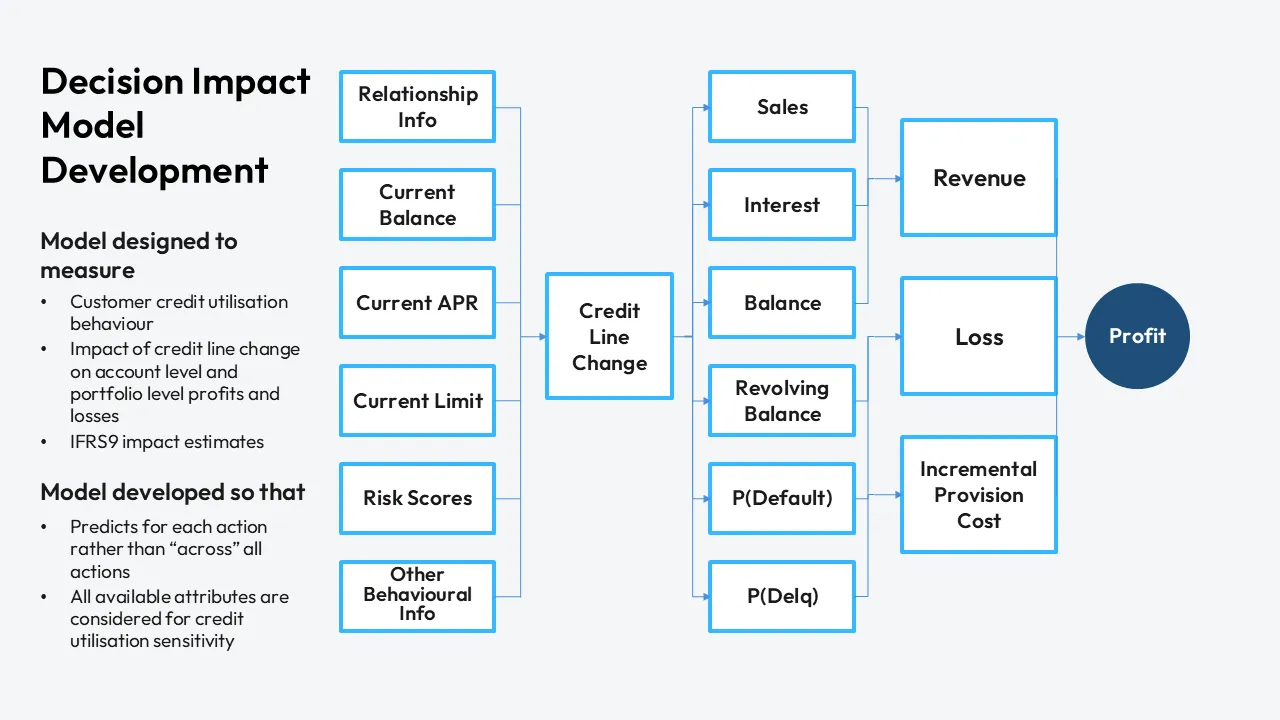
- Action-effect modelling transforms credit limit decisioning. By accurately predicting individual customer reactions to credit offers prior to any decision being made, action-effect models give decision-makers the flexibility to evaluate multiple scenarios across key performance metrics including balances and bad debt, ensuring every credit limit strategy is analytically grounded.
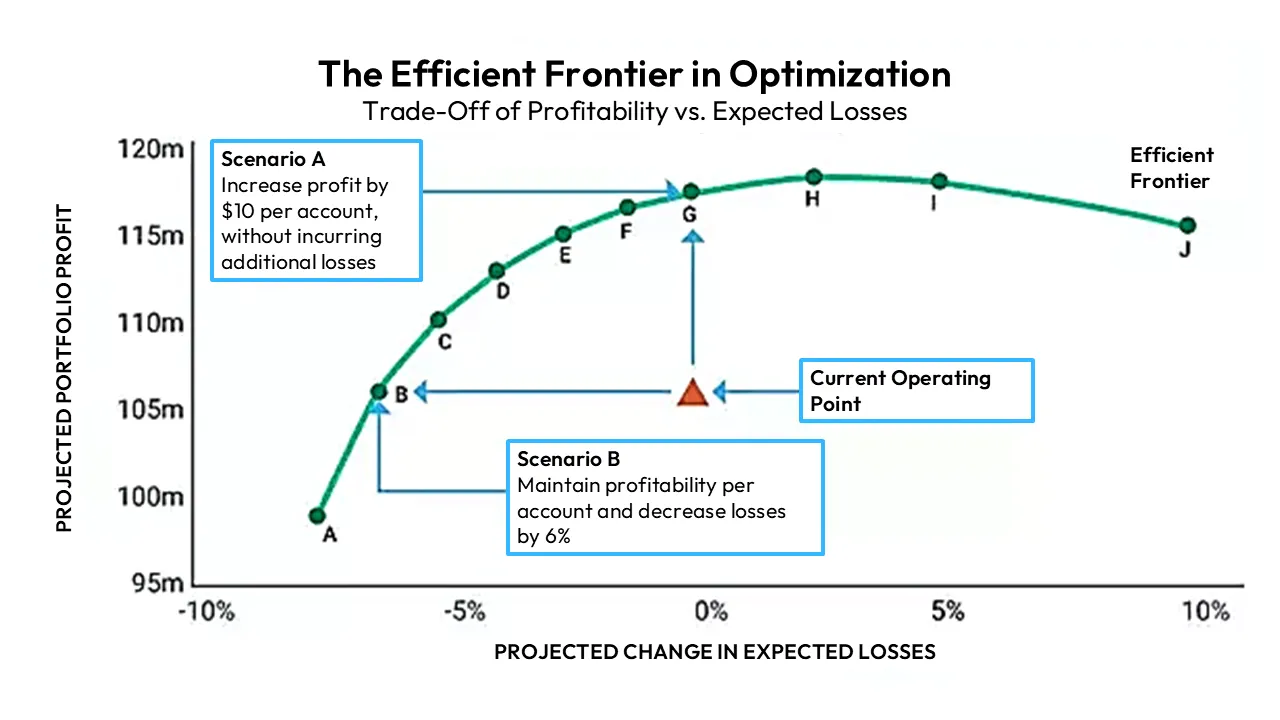
- The efficient frontier enables issuers to identify the optimal credit strategy. By visualizing trade-offs across multiple scenarios, the efficient frontier framework empowers issuers to select the strategy that best aligns with their growth objectives, market conditions, and profitability targets at any given time.
- Regulatory compliance and fair customer treatment can be built directly into optimization models. Constraints applied within the decisioning framework ensure that credit limit increase campaigns remain fully compliant, preventing unrealistic or unacceptable offers from reaching customers while preserving portfolio performance.
- FICO's credit offer optimization can deliver measurable, rapid, and self-sufficient results. With a proven global client base, FICO's optimization capability delivers tremendous value and equips internal teams with the knowledge and capability for long-term self-sufficiency.
The Challenge with Credit Line Management
Credit line management is regarded as a key driver to profitable portfolios. But despite this, many issuers fail to apply advanced prescriptive analytics to a crucially important process, or if they have, it may often be without a framework or infrastructure to maximize the effectiveness of the insights it can bring. Credit limit increase optimization – a core component of credit offer optimization is a powerful tool to achieve portfolio goals.
Action-Effect Modelling in Credit Limit Optimization
Among the underlying elements to optimizing credit limits is a need to have a detailed understanding of the impacts of any actions the issuer takes on their customers. Understanding the action-effect relationship is crucial to creating a solution that enables you to assess the likely impact of multiple alternative scenarios on key performance metrics, including balances and bad debt.
It enables decision-makers to define the best strategy easily and quickly for their credit line management campaign, while supporting critical business objectives. It's achieved by configuring a decision impact model, which includes and can leverage action-effect modelling.
Action-effect models provide two key advantages:
- They accurately predict how a customer will react to any offer, bringing great flexibility
- They drive vital insight into potential difficulties in managing the many dimensions of customer behaviour
The Efficient Frontier: Balancing Growth and Profitability
Among the crucial elements to understanding the art of the possible and potential value of credit limit increase optimization is the so-called 'efficient frontier', which enables issuers to compare differing scenarios and opt for the one that meets their growth objectives and market conditions at the time, while maximizing profitability.
Managing Profitability, Risk Exposure and Compliance in Credit Decisions
Credit line management optimization helps you manage more than just profit. Overall exposure can also be managed by balancing income and exposure, with risk level typically used as a constraint. The critical value is knowing how, where, and when accepting a slightly higher level of losses will drive an overall increase in the average profit per account and crucially by how much.
At the same time, CLI campaigns need to ensure they are compliant and don't offer customers unrealistic or unacceptable limit increases. Constraints can be applied to ensure that strategies are compliant and that they are treating customers fairly.
The Power of FICO Credit Limit Increase Optimization
Hundreds of FICO clients across the globe already benefit from optimization to deliver decisions that generate tens of millions of dollars — at speed and at scale. It's already well-established as a core analytics technology and proves optimal decisions can be consistently applied to help drive growth and improve financial performance across multiple industries and sectors.
Real-World Impact: UK High-Street Card Company
FICO recently delivered a credit limit increase optimization project for a UK high-street card company, with a potential yield of +£2 million (US$3 million) in annual profit improvement. Other benefits include:
- Speed — With direct access to data, value can be delivered in as little as eight weeks, subject to agreed project scope.
- No IT involvement — The solution requires little to no IT support. Credit limit strategies can be easily and quickly deployed to best suit client systems.
- Cost savings — Our approach, including all licence and professional services costs, typically delivers in-year return on investment.
- No long-term reliance on FICO — Beyond the initial solution development and software configuration, FICO provides detailed knowledge sharing and staff training to ensure all ongoing inhouse management and maintenance of the solution.
Award-Winning Client Success: Akbank and HSBC
Many FICO customers are achieving tremendous results using credit line optimization. Case studies include:
Akbank - Akbank partnered with FICO to deploy FICO® Platform Optimization Capability, leveraging action-effect modelling and decision impact models to determine the most profitable credit limit offer for each individual customer. FICO configured a decisioning framework that visualized trade-offs across multiple scenarios using efficient frontier analysis, enabling Akbank to select strategies that maximized profit while maintaining regulatory compliance and stable credit losses. The engagement delivered a 129% increase in profit, a 60% increase in approved credit limits, and a 45% increase in credit card approvals. For its achievements, Akbank was awarded the FICO® Decisions Award for AI, Machine Learning and Optimization.
HSBC- HSBC UK deployed FICO® Platform Enterprise Optimization Capability to transform its credit line increase strategy, leveraging eight action-effect models across 40 optimization scenarios to determine the most profitable credit limit offer for each individual customer. By replacing traditional champion-challenger testing with mathematical optimization and causal inference modelling, HSBC achieved a 15% uplift in monthly card spend, a 2% improvement in active customer rate, and a 6% boost in share of wallet, with no increase in financial risk or bad debt. For its achievements, HSBC was awarded the 2024 FICO Decisions Award for AI, Machine Learning and Optimization and the 2025 FStech Award for Best Use of Data Analytics.
How FICO Can Help You Optimize Credit Card Profitability
- To explore how optimization drives portfolio performance without increasing risk, Download the Agile Credit Card Limit Management Executive brief to Learn how FICO enables issuers to target the right customers with the right limits, drive portfolio profitability within regulatory and business constraints, and achieve significant profit improvement with negligible increase in risk delivered in as little as eight weeks, with minimal IT involvement and in-year return on investment.
- To understand how FICO® Platform Optimization Capability enables institutions to maximize credit limit increase profitability while maintaining regulatory compliance and stable credit losses, read the Akbank Case Study which details how FICO delivered a 129% increase in profit, a 60% increase in approved credit limits, and a 45% increase in credit card approvals without increasing credit losses.
- To understand how FICO® Platform Enterprise Optimization Capability enables institutions to automate and optimize credit line increase decisions while balancing customer needs, risk, and profitability, read the HSBC Case Study which outlines how FICO delivered a 15% increase in monthly spend, a 2% improvement in active customer rate, and a 6% increase in share of wallet, without increasing financial risk.
- To understand how FICO® Platform Enterprise Optimization Capability applies action-effect modelling and mathematical optimization to drive more profitable, data-driven credit decisions, download the FICO® Platform Enterprise Optimization Capability Brief and discover how leading financial institutions balance competing business objectives, manage risk, and deploy optimized strategies at scale.
- To learn how FICO® Customer Management unifies customer data, monitors customer value, and automatically determines the right action for each individual whether a credit line increase, a personalized cross-sell offer, or an early collections intervention visit the FICO Customer Management Solutions page. Discover how leading financial institutions use FICO's centralized, AI-powered decisioning to deliver real-time, analytically driven decisions across the entire customer lifecycle.
Note: This is an update of a post originally published in 2022.
Frequently Asked Questions
Many issuers will start with a base strategy, including looking at credit limit, utilisation, arrears status, time on books, number of times overlimit, revolver / transactor behaviour, implement that and then track it to see whether the customers offered the increase did actually use that extra credit given to them. The best approach to take involves action-effect modelling, which generates precise predictions of individual customer responses to specific credit offers prior to any decisioning being executed. By incorporating this with other analytics, you can systematically identify customers whose credit limit increase is most likely to generate incremental portfolio profit, while simultaneously excluding accounts where an increase would result in a disproportionate elevation of risk exposure. This avoids wasting a considerable amount of exposure, which needs to be taken into consideration with the IFRS9 models.
Credit offer optimization is architected to operate within existing account management environments with minimal technical disruption and no long-term dependence on external resources. Optimized credit limit strategies can be configured and deployed directly within established platforms, enabling institutions to operationalize data-driven decisioning rapidly. The solution requires little to no IT involvement, delivers value within an expedited implementation timeline, and is supported by comprehensive knowledge transfer and staff training to ensure full in-house management and maintenance capability following initial deployment.
FICO always recommends ensuring the decisions made are compatible with other account management decisions that may also be taking place at the same time. The aim may be to offer increases to customers who aren’t using their cards much today, with the expectation that these customers will then start to use the card more. This increase may be coupled with a pricing APR decrease or offer promotional or spend incentives (checks, BT offers, promotional rate) through the marketing area. Ensure that the two groups being targeted are the same and there is no inconsistency with decisions being taken.
The foundational methodologies underpinning credit offer optimization, including prescriptive analytics, action-effect modelling, and efficient frontier analysis, are product-agnostic and applicable across a broad spectrum of lending portfolios including personal loans, auto finance, and small business credit. The same analytical framework that simultaneously optimizes profitability, risk exposure, and regulatory compliance within a credit card portfolio can be configured to address the specific business constraints, product economics, and regulatory requirements of alternative lending product types. Optimization can also be applied across decision types, from pricing to collections. Authorisations is a good example — the decision of whether to approve a transaction that is over the card limit involves a lot of the affordability and risk considerations as a credit line offer.
Portfolio performance should be evaluated against a defined set of quantitative metrics encompassing average profit per account, credit loss rates, approval rates, credit limit utilization, card spend, revolving behavior and incremental balance growth among customers selected for limit increases. The efficient frontier framework provides a continuous strategic reference point, enabling portfolio managers to compare their current operating position against the full range of available optimization scenarios and to assess with precision whether the institution is maximizing profitability within its defined risk appetite and market conditions at any given time.
The long-term sustainability of a credit offer optimization programme is contingent upon institutional capability across three core disciplines.
- First, robust data governance and quality management frameworks must ensure that optimization models are continuously supplied with accurate, current, and comprehensive customer information.
- Second, advanced analytical expertise is required to develop, validate, refine, and monitor action-effect models as customer behaviour and market conditions evolve.
- Third, strategy management proficiency is essential to leverage the efficient frontier framework for ongoing scenario analysis, enabling decision-makers to continuously identify and deploy the optimal credit offer strategy in alignment with evolving business objectives and regulatory requirements.
However, these should not be viewed as blockers for a credit line optimization project. All good vendors provide knowledge transfer packages that cover all of the key knowledge requirements.

Popular Posts

Average U.S. FICO® Score at 716, Indicating Improvement in Consumer Credit Behaviors Despite Pandemic
The FICO Score is a broad-based, independent standard measure of credit risk
Read more
Has the Reporting of Rental Data to the Credit Reporting Agencies (CRAs) Increased?
FICO Score 10T includes rental data, but consumers can only experience the benefit of this to the extent that their rental data is reported to the CRAs
Read more
The GSE Data Is Public. Here's What It Shows About Credit Score Modernization.
Independent Milliman analysis of GSE historical data confirms what anyone can now verify directly: FICO® Score 10T is the most predictive score.
Read moreTake the next step
Connect with FICO for answers to all your product and solution questions. Interested in becoming a business partner? Contact us to learn more. We look forward to hearing from you.